Ideas for what to eat on the Budwig Diet

Some ideas for Foods You Can Eat on the Budwig Diet

One of the biggest surprises for people starting the Budwig Diet is just how much they can eat.

If you’re coming from a more traditional Western diet, the Budwig Diet may seem rather restrictive at first. In reality, only a relatively small number of foods are excluded.  The diet encourages you to eat a much wider variety of foods than you were eating before.

This isn’t a complete list of every permitted food, but it gives you a good idea of the types of foods that form the basis of the Budwig Diet. Eat a wide variety rather than relying on just a few foods. The foods you include are just as important as those you avoid.

Grains and Cereals

  • Amaranth
  • Barley (whole grain)
  • Brown rice
  • Buckwheat
  • Millet
  • Oats
  • Quinoa
  • Rye
  • Spelt
  • Whole wheat
  • Wholemeal bread (a little)

Vegetables

Choose a wide variety of naturally grown vegetables.

  • Leafy vegetables
  • Root vegetables
  • Stems and shoots
  • Brassicas
  • Potatoes
  • Fresh herbs
  • Vegetable stock

Raw salads are excellent, but vegetables can also be lightly cooked. Dr Budwig mentions boiling, although steaming is equally suitable.

Fruit

Fresh fruit of all kinds.

Pulses

  • Beans
  • Peas
  • Lentils
  • Chickpeas
  • Fresh and dried pulses
  • Beansprouts

Nuts and Seeds

  • Whole flaxseed (linseed)
  • Sprouted seeds
  • Nuts
  • Pumpkin seed oil
  • Pumpkin seeds
  • Sunflower seeds

Fermented Foods

  • Sauerkraut
  • Sauerkraut juice
  • Fermented pickles
  • Lacto-fermented vegetables
  • Traditionally fermented soy products
  • Traditionally fermented soy sauce

Dairy Foods

Dr Johanna Budwig specifically recommended several cheeses. It is important that these are traditionally-made rather than the plastic-wrapped, rubbery supermarket versions.  Only to be eaten in small amounts.

  • Brie
  • Camembert
  • Cheddar
  • Emmental
  • Goat’s cheese
  • Gouda
  • Jarlsberg

These cheeses are good sources of vitamin K₂. Choose cheese from naturally grass-fed animals whenever possible. Around 50 g per day is generally recommended, preferably at breakfast or lunch.

Quark

Cottage cheese

Strained Greek yoghurt

These are essential foods because they are used to prepare Budwig Cream.

Oils

  • Cold-pressed flaxseed (linseed) oil
  • Extra virgin organic coconut oil (for making Oleolux)

Drinks

  • Green tea (freely)
  • Black tea (occasionally, without milk or sugar; a little honey is acceptable)
  • Wine or Champagne (up to one glass a day)
  • Herbal tea
  • Freshly squeezed juices. These should have some ground flaxseed added to mitigate the fruit sugars

Other Foods

  • Raw honey
  • Nutritional yeast (yeast flakes)
  • Herbs
  • Spices

Nutritional yeast has a pleasant, cheese-like flavour and should not be confused with brewer’s yeast tablets or yeast supplements.

A Note on Whole Grains

The Budwig Diet traditionally includes whole grains such as wheat, oats, rye, barley, spelt and rice.

However, there is increasing discussion about the possible health effects of modern grains. If this interests you, Loren Cordain’s Wheat: Humanity’s Double-Edged Sword is worth reading as background. Eating wholegrains in a high fibre diet are usually tolerated better. Some people will find they do better on some grains than others.

Grains are more a “fill you up if still hungry” food than a staple on this diet.

Remember that this is only an introduction to the foods permitted on the Budwig Diet. Once you begin preparing Budwig meals, you’ll quickly discover there is far more variety than most people expect.
Budwig Diet for Hebe, a Springer Spaniel

My Experience with Hebe

Hebe, my dear old Springer Spaniel, had been fed mainly raw food together with a little Flax Farm cold-pressed flaxseed oil for about six years. I originally gave him the oil to help with stiffness in his spine and joints, and it certainly improved him.He was still charging around on long ten-mile walks at sixteen and would come out working at seventeen. At 18 he began to slow down  a bit and developed several growths, at least one of which I did not like the look of.

The vet agreed that, at his advanced age, if the growths were not bothering him, there was little point in operating and didn’tthink drugs would be fair at his age because one can never know whether an animal is suffering unpleasant side effects.  The vet agreed.

Hebe Hebe and Colin

Why I Chose the Budwig Diet

The Budwig Diet was developed by Dr Johanna Budwig in the 1950s. It remains popular as a holistic nutritional approach because it aims to support the whole body rather than simply address individual symptoms.

I had seen encouraging results in people who followed the Budwig Diet and had used it myself. I knew it was both practical and enjoyable, which gave me confidence in its principles.

Although Dr Budwig did not develop a version specifically for dogs, several of my customers had adapted it successfully for their own dogs. That, together with my own experience, convinced me it was the right approach for Hebe.

The human Budwig Diet is vegetarian and includes vegetable juices, salads and green tea. I did not feel that the full human version was appropriate for an elderly dog. Instead, I adapted it while keeping as closely as possible to Dr Budwig’s core principles.

Cold-pressed flaxseed oil for dogs
Flax Farm Cold-pressed flaxseed oil for dogs.

Principles of the Budwig Diet for Dogs

  • Plenty of omega-3 from flaxseed oil, thoroughly blended with dairy rich in sulphur-containing amino acids.
  • One or two portions of the Budwig mixture each day.
  • Stable blood sugar by avoiding refined carbs and using high-fibre ground flaxseed.
  • Plenty of antioxidants.
  • Adequate vitamins and minerals.
  • Support for gut health and a healthy microbiome.
  • Exclusion of all processed foods
  • Reduced stress.
  • Appropriate daily exercise.
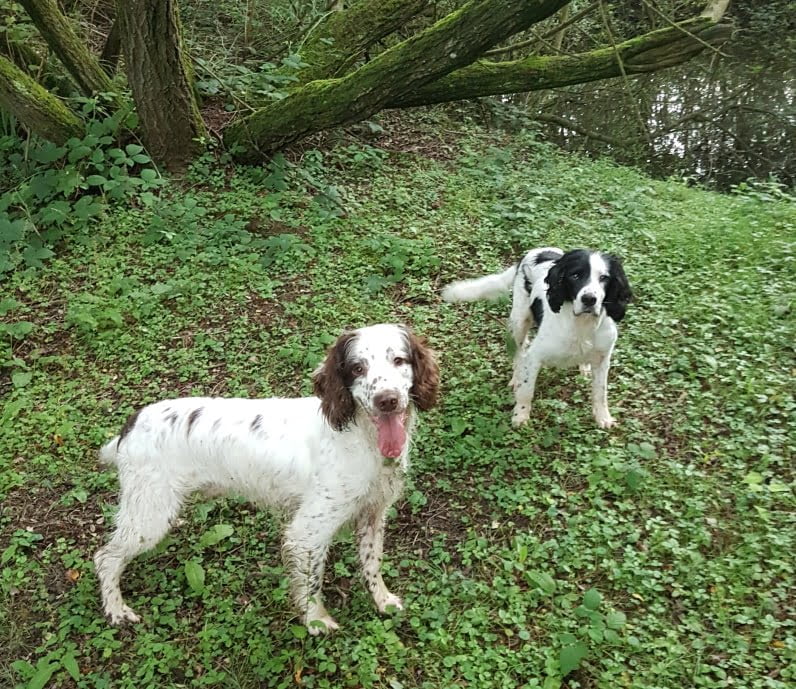
Two spaniels with glossy coats, aged nine and nineteen
Glossy coats on two spaniels aged nine and nineteen, both fed Flax Farm cold-pressed flaxseed oil.

Hebe’s Version of the Budwig Diet

To try to slow the development of the tumours, I decided to put Hebe on a dog-friendly version of the Budwig diet. He was eighteen when he started.

Within days, it was like changing his batteries. Other people noticed the difference too. At nineteen years and three months, only nine months short of twenty, he was still looking good, went most places at a smart trot, loved retrieving and could still do that at a canter.

His coat looked good. He had always been extremely active and demanding, following me from room to room and getting under my feet, and I was pleased to say that he remained mischievous, energetic and very much himself.

When I took him to the vet for a check-up at nineteen, she was amazed that a dog with such a massive heart murmur still had good colour in his gums and a strong, slow, steady heartbeat. His blood tests showed normal kidney function, liver function and blood sugar levels.

The Budwig diet for dogs combines cold-pressed flaxseed oil with quark
The Budwig diet for dogs combines cold-pressed flaxseed oil with quark.


Postscript

Hebe went on to reach twenty. He remained bright, active and very much the mischievous Hebe until the end.

Then a gastric bug spread through the local dogs. The younger dogs recovered after a few days, but it took too much out of Hebe. When life was no longer enjoyable for him, I made the heartbreaking decision to let him go.

I had owned him for eighteen and a half years. He had been a true friend and was completely irreplaceable.

Hebe aged nineteen, still active and mischievous
Hebe aged nineteen, still sprightly and mischievous, trying to raid the bird food.


Hebe aged eighteen and a half out for a run


Further Reading