
Equipment You’ll Need for the Budwig Diet
The Budwig Diet requires very little specialist equipment, but having the right tools makes preparing it much quicker and easier.
1. Hand Blender (Immersion Blender)
Blending the cottage cheese and flaxseed (linseed) oil
The most important piece of equipment is a hand blender. Its job is to thoroughly emulsify the flaxseed oil with the quark or cottage cheese to produce a smooth Budwig cream to the point that oil is no longer visible; then blend a bit more to ensure it’s completely emulsified.
Even inexpensive hand blenders usually work well, although more powerful models tend to emulsify the mixture more quickly and thoroughly.
I also recommend using a tall, narrow container rather than a wide bowl. A narrow jug or the beaker supplied with many hand blenders makes it much easier to blend relatively small quantities without the mixture climbing up the sides.
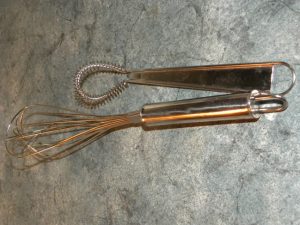
Can I use a hand whisk?
Yes. Even a fork can work. A traditional hand whisk will also produce a properly emulsified Budwig cream, but expect it to take considerably longer and require rather more effort. On the other hand, it still works perfectly well during a power cut!
2. Electric Coffee or Seed Grinder
Grinding flaxseed
Freshly ground flaxseed is an important part of the Budwig Diet.
A simple electric grinder with a rotating blade is ideal. The old-style burr coffee grinders are designed to produce coarse, even coffee grounds and are generally less suitable for flaxseed.
I recommend keeping one grinder exclusively for flaxseed—you probably won’t enjoy coffee-flavoured flaxseed, or flaxseed-flavoured coffee!
Choose a grinder that is easy to clean, as the natural oils in flaxseed can quickly become sticky.
3. A Juicer
If you intend to follow the full Budwig Protocol, a good juicer is well worth the investment because you’ll probably use it every day.
Freshly made juice tastes far better than shop-bought juice and will be infinitely more nutritious than shop-bought. You’ll be surprised how much you enjoy even those that are more veggies than fruit.
More expensive machines generally extract more juice, generate less heat during juicing and leave drier pulp, making them more economical over time. However, the most important consideration is to buy a machine that you enjoy using and don’t mind cleaning every day.
When choosing a juicer, consider:
- How easy it is to clean.
- The quality of the juice it produces.
- Whether it produces juice rather than froth.
- How dry the discarded pulp is.
- Noise.
- Reliability.
- Value for money.
Types of Juicer
Centrifugal Juicers
These are generally the least expensive and produce juice very quickly. They often have wide feed tubes, allowing whole fruit to be added with minimal preparation.
They are usually noisy but easy to use and clean. Their main weakness is that they are less effective with leafy vegetables and grasses.
Masticating (Cold-Press) Juicers
These work more slowly by crushing and pressing the produce rather than spinning it at high speed.
They generally produce higher-quality juice with less heat, extract more juice from the produce and are much better for leafy vegetables, wheatgrass and similar plants.
Horizontal auger models usually require more chopping beforehand because of their smaller feed tubes, while vertical models have larger feed chutes and are often easier to use, although they tend to cost more.
Manual Juicers
Manual juicers are inexpensive and can work surprisingly well for wheatgrass and leafy greens. They require more effort but may be perfectly adequate if you only make small quantities of juice.
Choosing a Juicer
There is no perfect juicer. The best one is the one you will happily use every day. Read current customer reviews before buying, as designs improve continually and today’s best machine may not be the one I would have recommended a few years ago. http://www.hacres.com/pdf/